
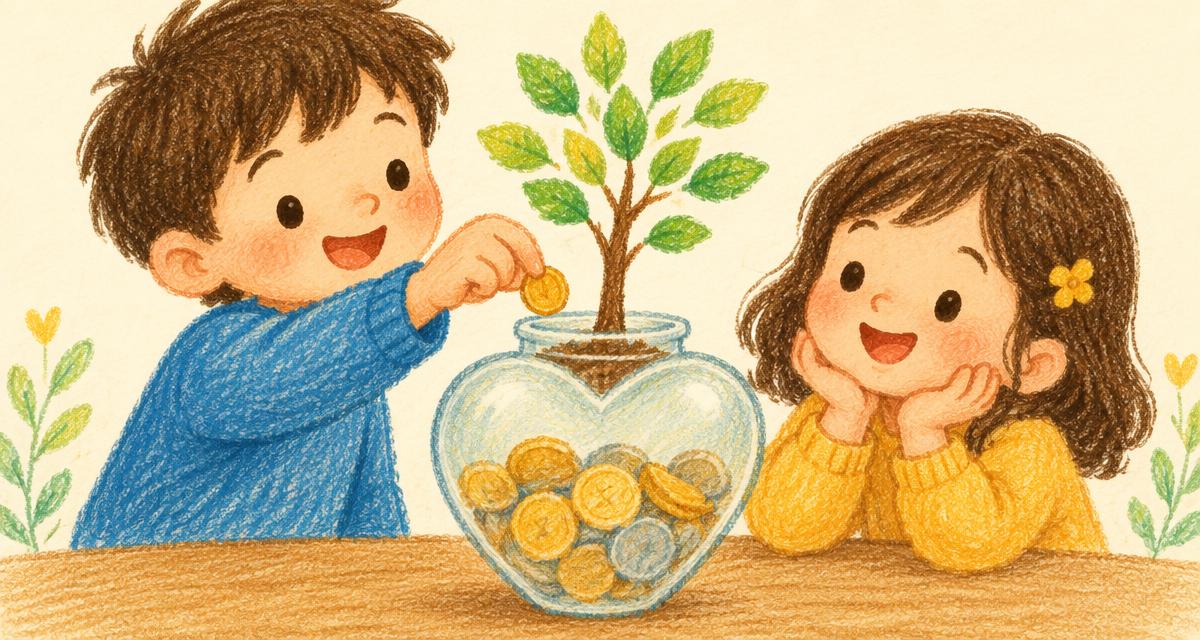
There is one jar children often skip: the share jar.
It seems strange, doesn't it? You worked hard. You saved carefully. Why would you give any of it away?
Let me tell you about Zara.
Zara and the pencils
Zara saved for eleven weeks for a set of colouring pencils. On the day she bought them, a boy in her class had nothing to draw with — his pencils had been left behind when his family moved.
Zara gave him four pencils. Just four, out of twenty-four.
She still had plenty. But something changed in her that day: she found out she was the kind of person who could help. That feeling stayed with her much longer than the pencils did.
What giving actually does
- It reminds you that you have enough. People who share feel rich, even when they are not.
- It makes your world bigger. Money spent on yourself ends with you. Money shared keeps travelling.
- It builds the muscle. Kind grown-ups were once kind children who practised.
How much?
Not everything. Never everything. A tiny amount, every time, is stronger than a big amount once.
Many families use one coin in ten. Get ten, share one. Get twenty, share two. It is small enough that you never feel it, and regular enough that it becomes who you are.
Sharing is not only money
You can share your time, your turn, your snack, your seat, your patience with a little brother. All of it counts. Money is just the easiest one to count.
Try this today
Open your money page in your kids zone and decide your share number: one coin in ten? One in twenty?
Then decide who it goes to — a person, an animal shelter, a friend who needs something. Tell your grown-up your plan. Saying it out loud is what turns a nice thought into a real habit.