
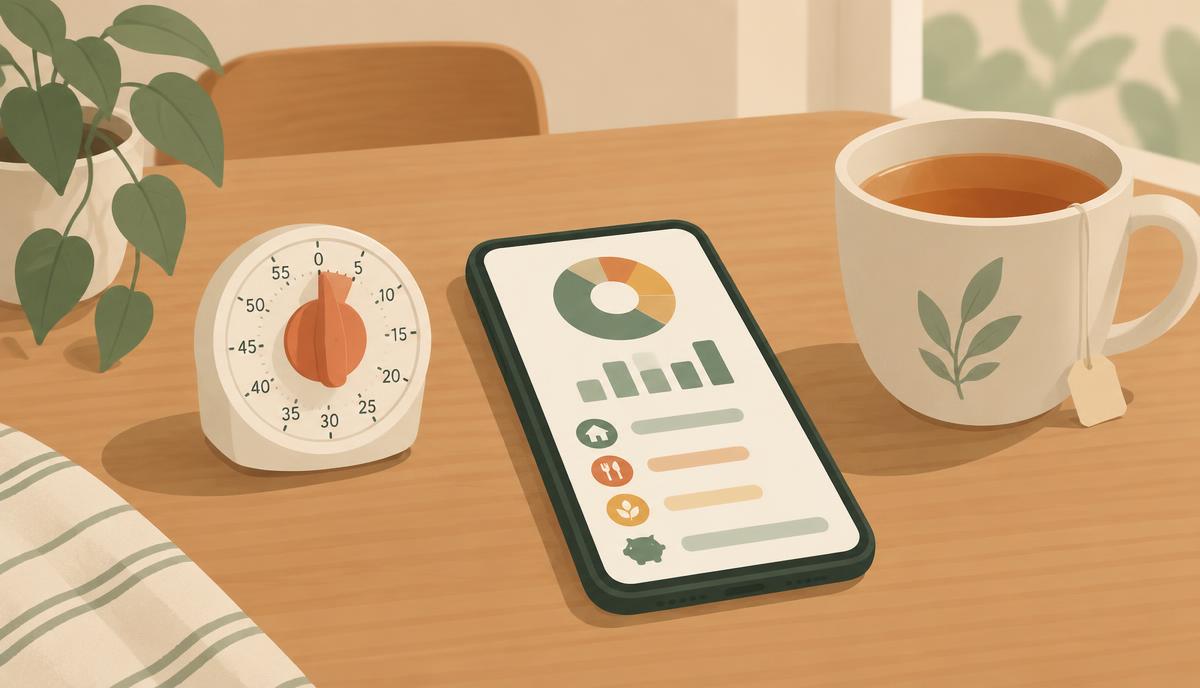
When people say "I am bad with money", they almost never mean the maths. Splitting a bill is not hard. Reading a bank balance is not hard.
What they mean is: money keeps surprising them. And you cannot manage what keeps surprising you.
The spreadsheet trap
The classic response is to build the perfect system — a spreadsheet with 40 categories, colour coding, formulas. It feels productive. It lasts about three weeks.
Here is why: a system you have to maintain is a second job. The enemy of money management is not laziness — it is friction. Every extra step between "I should check" and "I checked" is a place the habit dies.
What actually works
Money management, reduced to its honest minimum, is three questions:
- What came in this month?
- What went out — and was it what I expected?
- What is left, and does anything about that number need a decision?
Five minutes, once a week, is enough. Not because deep analysis is worthless, but because the five-minute version is the only one that survives real life. A habit you keep beats a system you abandon. Every time.
The surprise tax
Every month you do not look, money charges you a hidden fee: the surprise. A subscription you forgot. A swing in grocery spend. A card payment that quietly doubled. None of these are disasters. But ten small surprises a month is a background hum of anxiety — the reason people avoid opening the banking app in the first place.
Visibility kills the surprise. Kill the surprise and the anxiety goes with it.
Where it usually breaks
For most people it is not one account — it is four. A salary account, a second bank, a wallet of cash, maybe a business account quietly bleeding into the personal one. No five-minute habit can survive money living in four places. The habit does not fail. The setup does.
Why this matters to us at Hisaab
Hisaab exists to fix the setup, so the habit can be as small as it should be. All your accounts — personal, business, cash — in one honest place, already categorised, already separated.
Then money management stops being a project and becomes what it was always supposed to be: a five-minute look at a picture that tells the truth.