
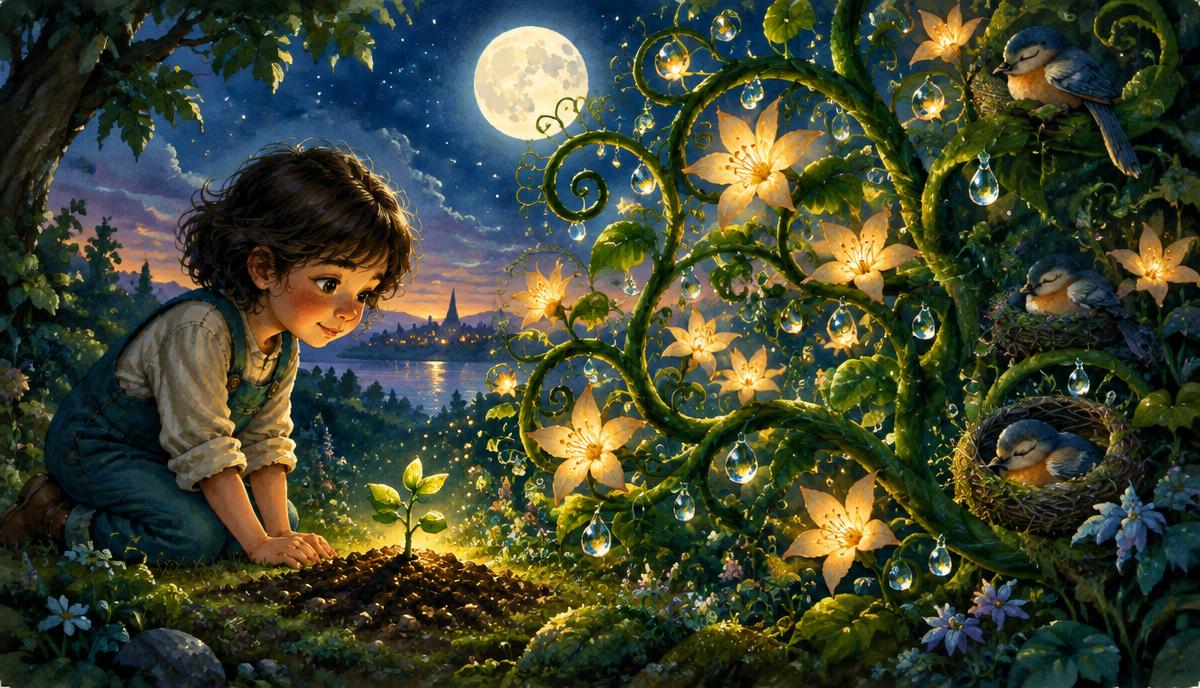
Nothing in the pot
Every morning, Ishaan checked his flowerpot before breakfast.
On Monday there was soil.
On Tuesday there was soil with a crumb on it.
On Wednesday the crumb had gone, which was interesting, but not the kind of interesting he wanted.
His sister’s beans had already climbed a string. At school, a friend’s sunflower had opened two leaves like tiny green hands.
Ishaan’s pot held nothing he could show anyone.
He had planted three moonflower seeds with his grandfather. They had watered them gently and set the pot where the morning sun warmed the sill.
“Maybe I’m not good at growing things,” Ishaan said.
Grandfather looked up from peeling an orange. “The seeds haven’t told us much yet.”
“But everyone else has something.”
Grandfather divided the orange and gave him half. Juice ran cool across Ishaan’s fingers.
That evening, Ishaan moved the pot beside his bed. If anything happened, he wanted to be there.
Near midnight, he woke to a sound like someone brushing sand with a feather.
A silver ladder leaned out of the soil. At its top stood a snail carrying a lantern on its shell.
“Coming?” the snail asked. “The paths are pleasantly damp.”
Under the sleeping surface
Ishaan slipped from bed. As he touched the ladder, it grew—or he grew smaller. He could not tell which, and the snail seemed uninterested in measuring.
They climbed into the pot.
Beneath the soil was a wide, warm garden lit by pale mushrooms. Roots arched overhead like the ribs of little boats. Water gathered on their tips, trembling before it fell.
Ishaan smelled rain, even though his bedroom had been dry.
“I thought there was nothing here.”
“Nothing visible from your window,” said the snail.
A root no thicker than thread eased past a pebble. Two worms were making a tunnel around a sleeping seed. Farther away, a beetle polished a drop of water until it reflected the mushroom light.
“Is everyone working?” Ishaan asked.
The snail turned its lantern toward a hollow where several beetles lay upside down, snoring.
“Certainly not.”
They passed a seed wrapped in a soft brown coat. It made a small cracking sound.
“Is that mine?”
“One of yours.”
“Can we hurry it?”
“We can give it room.”
Ishaan stepped back, though he had not realised he was leaning close enough to cast a shadow across it.
The room of resting seeds
At the garden’s centre stood a round room lined with moss. Seeds rested in little hollows along its walls.
Some were fat and shiny. Some looked like commas. One had a feathery tail that tickled whenever the breeze came through.
“Why aren’t these growing?” Ishaan whispered.
“Different reasons,” said the snail. “Some are waiting for warmth. Some need more rain. Some may never sprout.”
Ishaan looked sharply at his guide.
“Never?”
“It happens.”
He had expected the night garden to promise a magnificent flower by morning. Perhaps a flower taller than his sister’s beans. Perhaps everyone would gather at his window and stare.
Now he sat on a mossy ledge, feeling disappointed all over again.
“What if none of mine grow?”
The snail settled beside him. Its lantern made a small amber circle around their feet.
“Then you’ll have a pot of soil, and you’ll still be welcome here.”
They listened to water dripping somewhere beyond the room.
After a while, Ishaan noticed that the seed beside his knee had a beautiful pattern on its shell: tiny dark waves, almost like writing.
He had been looking so hard for a flower that he had not looked at the seed.
The garden’s slow festival
A distant bell sounded once.
“Dewfall,” said the snail. “Would you like to see?”
They followed a root into an open cavern. Above them, the underside of the soil glittered with water. Each drop held a tiny upside-down bedroom: Ishaan’s bed, his slippers, the moonlit window.
Then the drops began to fall.
Worms curled into loops. Beetles opened their wing cases. The roots drank quietly while the snail raised its face to the cool shower.
Ishaan held out his palms.
There were no banners announcing the fastest root. Nobody measured the sleeping seeds. The festival consisted mostly of being damp together, which turned out to be wonderful.
Before he left, Ishaan helped move a small pebble away from a new root. Then he sat down again. The garden did not ask for another task.
At dawn he woke in bed with a grain of soil between his fingers.
Nothing had appeared in the pot.
He watered it anyway, then went outside to play.
Six mornings later, a pale hook lifted through the soil. Ishaan called Grandfather, and they admired it together. Of the other two seeds, one emerged much later. The last remained a mystery.
Ishaan left space for it, but he did not spend every afternoon waiting at the window.
A little light to carry
On warm nights, Ishaan imagined the garden beneath his pot: the roots drinking, the beetles sleeping, the patterned seed keeping its own small silence. Sometimes he wished he could grow tall as quickly as the beans. Sometimes he was glad to be exactly the right size for Grandfather’s lap, with an orange divided between them.
The first moonflower eventually opened after sunset, pale and fragrant as a piece of moon. Ishaan loved it. He had also been loved on all the mornings when there was only soil. When the flower closed again, he left the curtains open for the snail’s lantern and climbed into bed, where nothing more needed to bloom before he could rest.