
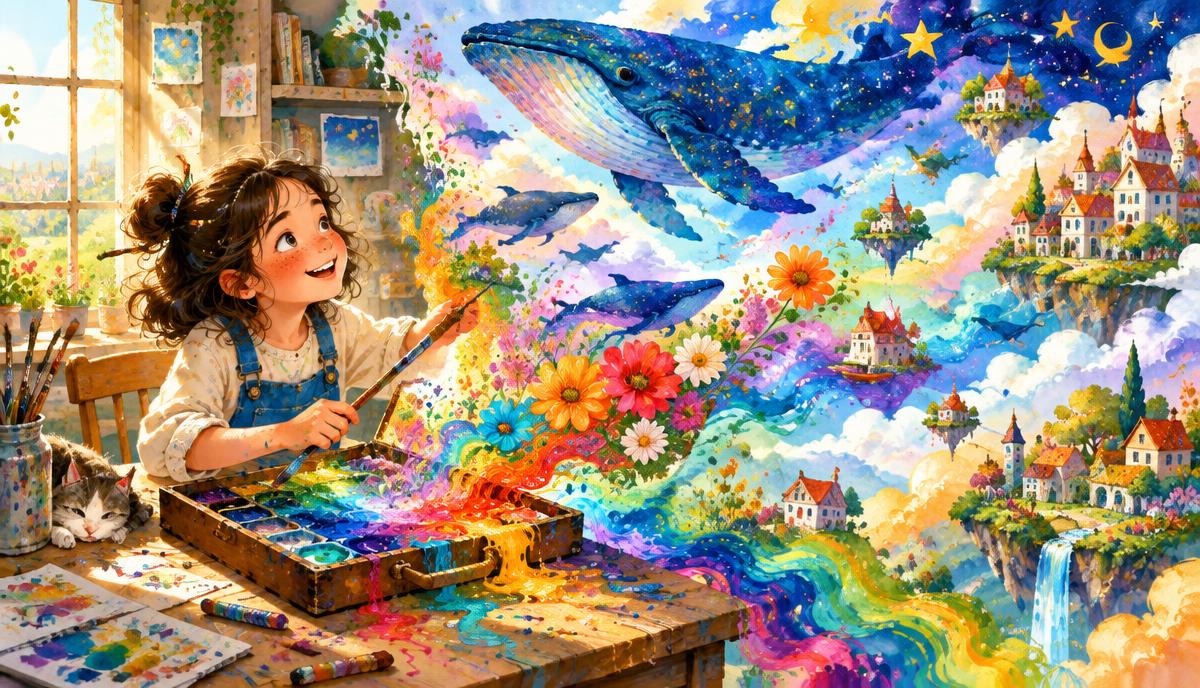
The colour that would not come
Anaya wanted to paint the evening she and her grandmother had eaten mangoes on the roof.
She remembered the juice cooling her wrists. She remembered a neighbour singing below, and the first evening star caught between two washing lines.
Most of all, she remembered the sky.
It had been pink, but not this pink.
She added yellow. Now it looked like soup.
She added blue. Now it looked like a bruise on a plum.
By lunchtime, six crumpled sheets lay beside her chair. The seventh held a sky so carefully painted that she was afraid to add anything beneath it.
Grandmother brought cucumber slices with salt.
“How is the evening coming along?”
“It isn’t. I can’t get it right.”
“Perhaps the evening has moved.”
Anaya frowned. She wanted the real colour, not a riddle.
After Grandmother left, she opened an old paintbox found at the back of the cupboard. Inside were twelve shallow pans, all empty.
Then a drop of violet rolled across one pan.
“Empty?” it said indignantly. “We were taking a walk.”
The lid unfolded into a staircase, and a warm, paint-scented breeze lifted Anaya’s hair.
Through the country of colour
At the foot of the staircase lay a meadow that changed whenever Anaya blinked.
First the grass was emerald. Then it was the pale green inside a cucumber. Then it became a green she had no name for, with a little gold hiding underneath.
The violet drop bounced beside her.
“I’m looking for the colour of an evening,” Anaya said.
“A particular one?”
“Yes.”
“How troublesome. Evenings are always borrowing things.”
They crossed a bridge over a yellow river. Beneath the bridge, the yellow turned amber. In the sunshine, it flashed nearly white.
At the far bank stood a market of shades. A woman poured blue from a kettle into little cups. Each cup held a different blue.
“Which is the proper one?” Anaya asked.
“For what?”
“The sky.”
The woman tilted a cup. Inside it, a thundercloud drifted over a summer beach.
Anaya walked on, carrying a brush the violet drop had lent her. It had a crooked wooden handle and bristles that leaned in several directions.
“Doesn’t anyone have a better brush?”
“Possibly. This one likes trees.”
The brush trembled pleasantly in her hand as they approached a forest the colour of warm cinnamon.
The hall of exact matches
Beyond the forest stood a white building without a single mark on its walls.
THE HALL OF EXACT MATCHES, read the door.
“At last,” Anaya said.
Inside, thousands of coloured tiles covered shelves from floor to ceiling. A courteous attendant carried a magnifying glass.
Anaya described her evening sky. The attendant brought a tile.
“Too orange.”
Another tile.
“Too pale.”
Another.
“Almost.”
They searched until the light through the windows began to fade. Anaya’s shoulders ached. She could no longer remember whether the original sky had been more pink or more gold.
The attendant set down the magnifying glass.
“Would you like to sit?”
“But we haven’t found it.”
“We have chairs anyway.”
Anaya sat. The violet drop rested on her shoe.
“What if I paint it wrong and spoil the memory?” she whispered.
From her pocket, she took the crumpled first attempt she had somehow brought along. There was a thumbprint at one edge, where mango-coloured paint had smudged the paper.
Suddenly she remembered Grandmother laughing with juice on her chin.
The memory had survived seven unsuccessful skies. It was still there, sweet and untidy, waiting without a magnifying glass.
The sky with room in it
Outside the hall, a great blank sheet stretched between two cinnamon trees.
“May I?” Anaya asked.
The violet drop bowed.
She dipped the crooked brush into the yellow river. She borrowed pink from a passing cloud and blue from the shadow beneath her own shoe.
The first stroke dripped.
She watched the drip travel downward. It looked a little like a washing line, if a washing line could melt.
She painted clothes hanging from it.
Then she added the roof, a plate of mango slices, and Grandmother’s bare feet. One foot was larger than the other. Anaya considered fixing it, then remembered how close that foot had been to her own.
The violet drop settled into the painted evening as a small purple bird.
“It wasn’t there,” Anaya said.
“Would you like me to leave?”
She looked at the bird.
“No. You can stay.”
The sheet billowed. For a moment, painted washing fluttered in a real breeze, and the whole colour country smelled of ripe mangoes.
Then Anaya was back at her table.
Her painting was not the evening. It was something she had made while remembering the evening.
Grandmother came to look.
“Oh,” she said, touching the table beside it. “I remember how warm the roof was.”
A little light to carry
Anaya kept one sheet unpainted at the back of her folder. Not because she was saving it for a masterpiece, but because she liked its open space. Another day, it might hold a purple bird, a very large foot, or a colour that looked suspiciously like soup. It could also remain a sheet of paper for as long as she wished.
When she and Grandmother ate mangoes again, Anaya noticed the sky without trying to trap it. It changed while they watched. Grandmother passed her another slice, and the evening made room for sticky fingers, uneven laughter, and a child who did not need to paint anything beautiful to belong there.