
Before anyone was watching
Dev woke before his alarm and lay listening to the ceiling fan.
Yesterday’s school race was still replaying in his head: the bend, the tightening in his legs, the other runners drawing away. He had finished sixth. His father had hugged him afterward, but Dev had kept looking past his shoulder at the medal table.
Now his running shoes waited by the door.
He had promised himself an early run. No race, no crowd. Just the canal path before breakfast.
For several minutes, he considered staying in bed. Then he dressed, left a note on the kitchen counter, and stepped outside.
The town was blue with early morning. A baker lifted shutters. Somewhere, a broom whispered over stone. The air smelled of yeast and last night’s rain.
At the canal, Dev stopped.
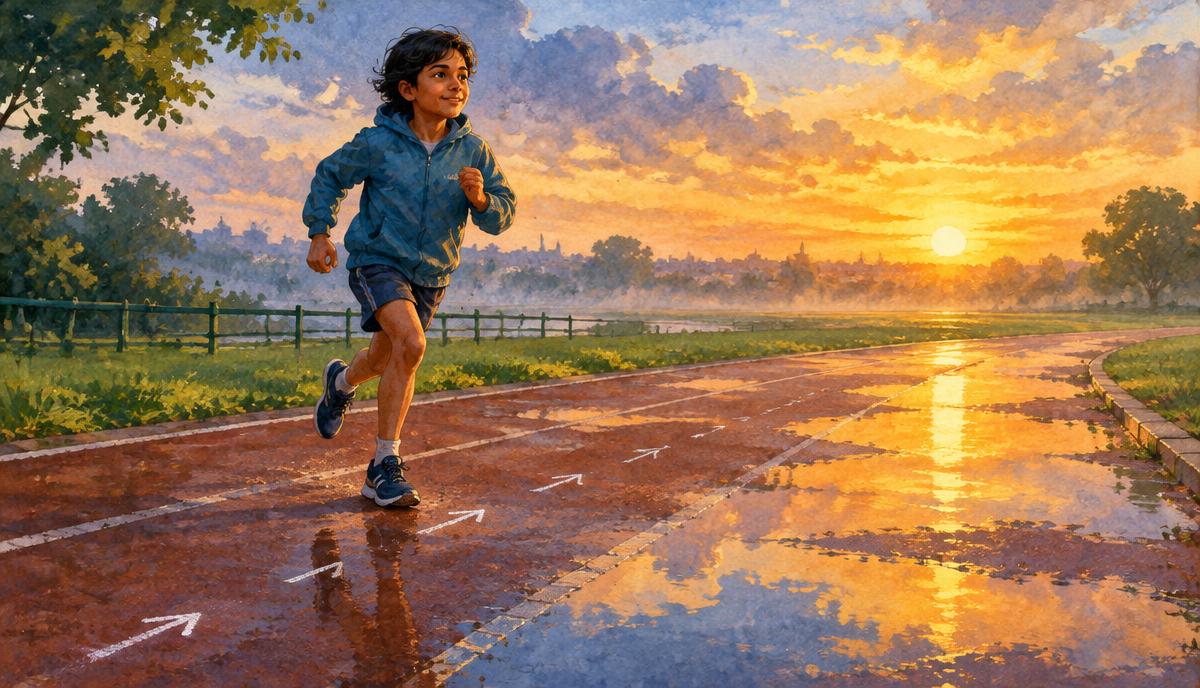
A narrow red running lane had appeared beside the water. It curved beneath the willow trees and continued farther than he could see.
There was no banner, only a wooden sign.
THE RACE NOBODY SAW.
Below it: ENTER IF YOU WISH. LEAVE WHEN YOU WISH.
Dev looked for a camera, an organiser, a joke.
A moorhen stepped across the lane and vanished into the reeds. Nothing else moved.
The lane beyond the town
Dev put one foot on the red surface. It felt springy, like moss beneath a carpet.
He began to run.
For a while the canal stayed beside him. Then the water widened into a lake, and the houses gave way to tall grass beaded with dew.
There were other lanes now, but no other runners. In the lane to his left, a shadow kept pace with him.
It was his own shadow, stretched long by the rising sun. Yet it ran with the smooth, effortless stride he always imagined having.
Dev accelerated.
The shadow accelerated too.
He tried harder. His breathing grew noisy. The shadow remained just ahead.
At the next bend stood a bench and a water jug. A groundskeeper in a faded hat was clipping grass around the legs.
“Where’s the finish?” Dev asked, slowing reluctantly.
“Farther along.”
“How far?”
“Depends where you’re going.”
Dev disliked this answer. “Is anyone keeping time?”
“No.”
“Then how do I know if I’ve done well?”
The groundskeeper set down the shears.
“Would you like some water before deciding what you want to know?”
Dev accepted the cup. His hand shook slightly from running too fast, and he was glad nobody commented.
The part without cheering
He sat on the bench longer than intended.
Without a clock, the pause felt strange. There was no official reason to stop, and no official reason to start again.
Across the lake, reeds leaned in the wind. The shadow waited on the path, ordinary and flat now.
Dev thought about yesterday. He had trained for weeks. He wanted the result to show that those weeks mattered.
Instead, sixth place seemed to have swallowed everything: the cold mornings, the new steadiness in his breathing, the first time he had run the hill without walking.
“If nobody knows how hard you tried,” he said, “does it disappear?”
The groundskeeper considered this.
“I wasn’t here when that willow grew its roots.”
Dev looked at the tree, then back at the cup. He did not want a tidy answer. He wanted, still, to have come first.
“I’m disappointed,” he said.
“I believe you.”
The groundskeeper returned to the grass.
After a while, Dev stood. He might run farther. He might go home. Neither choice would change yesterday’s results, and for the first time that morning, he let that be true.
He placed the cup beside the jug and began again, slowly.
Across a line of light
This time Dev let his breath choose the pace.
He noticed things he had missed: a feather turning in a puddle, the cinnamon smell of dry leaves, the soft knock of seedpods against one another.
The lane rose over a low hill. Halfway up, his legs grew heavy.
He walked.
No whistle blew. The lane did not close beneath him. At the top, he could see the lake shining behind him and, ahead, the familiar rooftops of town.
A line of sunlight lay across the red surface.
Beside it stood another sign: A FINISH, IF YOU WANT ONE.
Dev laughed under his breath.
He ran the last few steps. Not a sprint. Just enough to feel his body moving freely through the morning.
Beyond the line, the red lane became the ordinary canal path. There was no medal, no envelope, no secret crowd springing out to applaud.
For a moment, he felt the old hollow tug.
Then a breeze cooled his face. He was tired. He was hungry. He was glad he had come.
At home, his father was making toast.
“How was your run?”
Dev considered telling him about the lake and the impossible lane.
“Strange,” he said. “Good. I walked some of it.”
His father moved a plate toward him. “Jam?”
“Yes, please.”
A little light to carry
Dev still wanted to run faster. He still entered races, and losing still stung. But he stopped asking every finish line to explain who he was. There were mornings when training felt wonderful, mornings when it felt ordinary, and one rainy morning when he stayed home making breakfast with his father instead.
He never found the red lane again. Sometimes sunlight fell across the canal path in a way that reminded him of it, and he would feel a quiet fondness for the boy who had crossed alone. Not because that boy had secretly won something. Because he had been there, breathing, disappointed, curious, alive—and there had been a place waiting for him at the kitchen table all along.